The Pilgrimage I Didn’t Know I Needed
“How does a woman return to herself?”
It is a question that has quietly followed me for years.
How do we truly honour the divine feminine within us? Is it found in another designer handbag, a new pair of heels, or another item to add to an already overflowing wardrobe? Or is it something much quieter? Something deeper. A gift that cannot be bought, only remembered.
Nearly ten years ago, I stumbled across Meggan Watterson’s book Mary Magdalene Revealed. Or perhaps I didn’t stumble across it at all. The universe has a curious habit of placing exactly what we need in front of us long before we realise why.
From the moment I turned the first few pages, something stirred. Deep inside, I knew that one day, when the time was right, I would travel to the places in southern France where the story of Mary Magdalene still lingers among caves, mountains and ancient forests.
As both a ‘theologian enthusiast’ and schoolteacher of Religious Education for more than twenty-five years, I was captivated by Meggan’s research into the fourth-century texts discovered in Egypt. Here was a buried Gospel attributed to Mary Magdalene, revealing a radically different understanding of Christianity from the one many of us inherited.
Raised within the Christian faith and having taught those traditions throughout my career, I found myself asking a difficult question.
If I have only ever been shown one story, how do I know there isn’t another waiting to be remembered?
Over the past decade my own journey has resembled what Carl Jung described as individuation, the slow and often uncomfortable process of becoming who we truly are.
Others may have called it a midlife crisis. Some perhaps a breakdown. A few may even have considered it selfish.
I simply call it coming home.
The journey has taken me in directions I never expected. Karma Yoga in Mexico before my mother’s illness brought me home. Studying the Yoga Sutras in the holy city of Rishikesh. Countless hours of silence, meditation, cold rivers, dance, writing, conversations and uncomfortable truths.
Each experience gently chipped away at who I thought I should be until there was enough space to discover who I already was.
As I read Mary’s Gospel alongside Eastern philosophy, I couldn’t ignore the similarities. Meggan writes about Mary’s Seven Powers of Liberation. Having immersed myself in yogic philosophy, I instinctively recognised echoes of the seven chakras, not as identical teachings, but as parallel invitations towards integration, healing and wholeness.
It also left me quietly wondering.
If traditions separated by continents can arrive at such similar wisdom, perhaps Truth has always been speaking many languages.
Perhaps we simply forgot how to listen.
This pilgrimage had been twelve months in the making.
Like many women juggling busy lives, trying to align four diaries proved harder than finding enlightenment.
Eventually, everything fell into place.
Or so we thought.
Instead, we arrived during one of the hottest Julys southern France had experienced. Forest fires had closed the paths leading to Sainte-Baume. The cave where Mary is believed to have lived for thirty years before her death was inaccessible. Rivers had almost disappeared. Rangers guarded the woodland. Gatherings were cancelled. Even our long-table supper with our local guide and chef had to be abandoned.
Not exactly the spiritual itinerary we’d imagined.
As an enthusiastic wild swimmer and lifelong hiker, I’d imagined wandering mountain paths in quiet contemplation.
Instead…
The pilgrimage began teaching before we’d even unpacked our bags.
Isn’t life wonderfully inconvenient like that?
I cannot speak for the other women, because every pilgrimage is deeply personal.
But I can say this.
I didn’t receive what I planned.
I received exactly what I needed.
For nine beautiful days, Mary’s Gospel quietly unfolded, not through ancient ruins, but through ordinary moments.
Bedtime readings from Meggan’s book as Nicola gently read aloud while moonlight settled over our woodland caravan beneath Sainte-Baume and cicadas hummed us to sleep.
Navigating France with what affectionately became known as “four back-seat drivers” in one hire car. Remarkably, nobody was left on the roadside.
Choosing curiosity over conflict.
Responding rather than reacting.
Meeting, not merging.
There were moments when frustration appeared. Mary names rage as one of the Seven Powers, not something to suppress but something to understand.
How different our relationships become when anger is no longer an enemy, but a messenger.
Pilgrimage, it turns out, isn’t only about sacred destinations.
Sometimes it’s about deciding whose turn it is to drive.
Who makes the coffee.
Who carries the picnic.
Which beach feels right today.
Whether the morning begins with meditation…or coffee…or, let’s be honest, coffee before meditation.
These seemingly ordinary moments become extraordinary opportunities to practise compassion, patience and presence.
We also took our responsibilities as pilgrims very seriously by conducting extensive research into French pâtisseries.
It would have been deeply disrespectful to sample only one cake.
Some sacrifices simply have to be made.
There were cliff jumps into turquoise waters alongside fearless local children. Lavender markets overflowing with handmade treasures. Conversations in hesitant French that somehow always found their way. Little victories that quietly reminded us how expansive life becomes when we allow ourselves to remain beginners.
One of my favourite memories happened quite unexpectedly.
We heard Michael Jackson echoing through the narrow-cobbled streets of Bandol.
Naturally, sensible women approaching middle age did what any respectable pilgrims would do.
We followed the music.
Moments later we found ourselves dancing with complete strangers in an open-air disco overlooking the harbour, shopping bags swinging from our wrists, laughing until our faces hurt.
I have absolutely no recollection of looking dignified.
And I wouldn’t change a second of it.
Perhaps the greatest surprise came when we visited the Basilica of Saint-Maximin.
Quite by chance, we arrived during a festival dedicated to Mary Magdalene.
The church was overflowing.
Candles flickered beneath magnificent artwork. Male voices rose through the cathedral in haunting harmony. Men, women and children sat together listening intently to a sermon celebrating Mary’s teachings.
For the first thirty minutes I enthusiastically translated the French in my head.
Then my brain politely resigned.
Fortunately, our beautiful French-speaking friend Maddie later shared the priest’s words with us.
His reflections moved me deeply.
What struck me most was not only what he said.
It was who was listening.
Perhaps this is what a balanced spirituality looks like.
Not women replacing men.
Not men fearing women.
But masculine and feminine wisdom standing side by side, each honouring the other.
That feels far closer to the teachings of Yeshua than the divisions we have inherited.
Those who have eyes, see.
Those who have ears, hear.
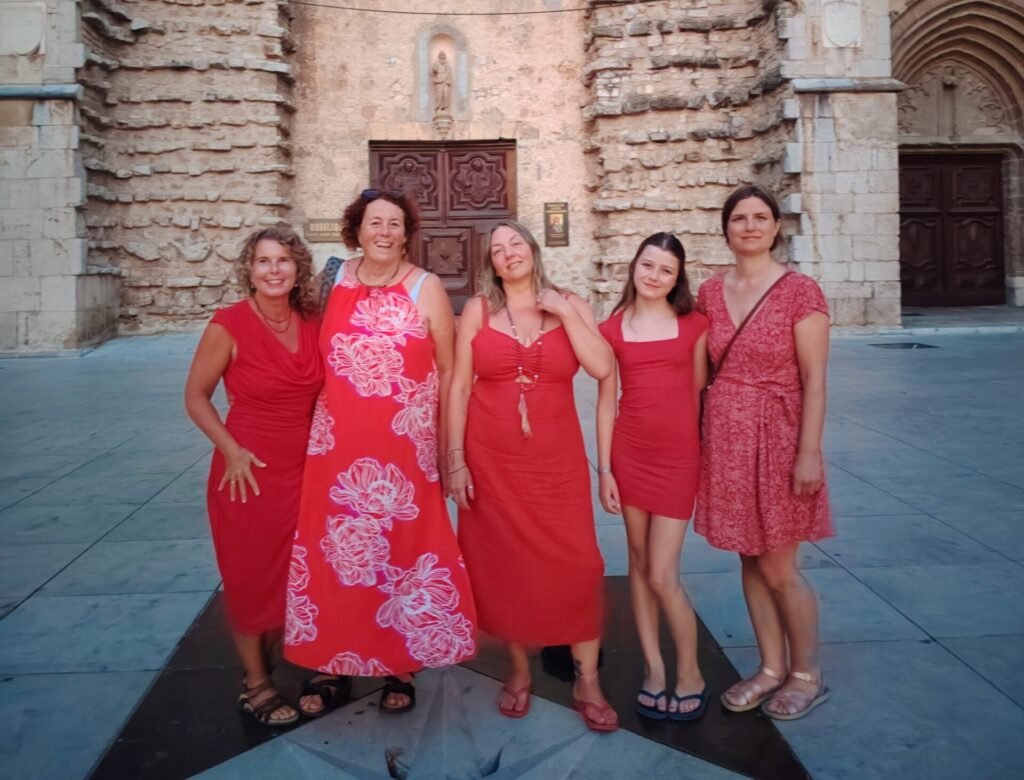
On our final evening, we wore red dresses.
Not because anyone told us to.
Because somehow it felt right.
As we shared a final meal together, I realised that although we hadn’t climbed every mountain or entered every sacred cave, each one of us had found something infinitely more valuable.
Ourselves.
Or perhaps…a little more of ourselves.


I came home with deeper peace than I left with.
A quieter mind.
A softer heart.
A renewed trust that healing rarely happens where we expect it to.
It happens in the spaces between.
In shared laughter.
In tears that don’t need explaining.
In dancing barefoot.
In saying sorry.
In saying thank you.
In choosing love again and again.
Mary Magdalene, for me, represents far more than a historical figure.
She reminds us that wisdom lives within the body as much as the mind.
That compassion is strength.
That courage often whispers rather than shouts.
And that becoming fully human is perhaps the holiest pilgrimage any of us will ever make.
For years I’ve asked one question through my writing, my teaching and my own life: How do we become more fully human? I think Mary Magdalene has been quietly answering it all along.
So, I leave you with one question.
If Mary Magdalene walked beside you for just one ordinary day, not as a saint on a pedestal, but as a wise woman and trusted friend, what would she gently invite you to remember about yourself?
I have a feeling the answer isn’t hidden in a cave in the south of France.
It’s probably been quietly waiting inside you all along.